
A business can have 10,000 Instagram followers and still struggle to generate customers.
Another business can spend thousands on Google Ads and still waste most of its advertising budget.
The problem is usually not the platform.
It is the strategy behind the platforms.
A good digital marketing strategy is not about choosing between social media, content, Google Ads, Meta Ads or SEO. It is about understanding what each channel is supposed to do and connecting them into one customer journey.
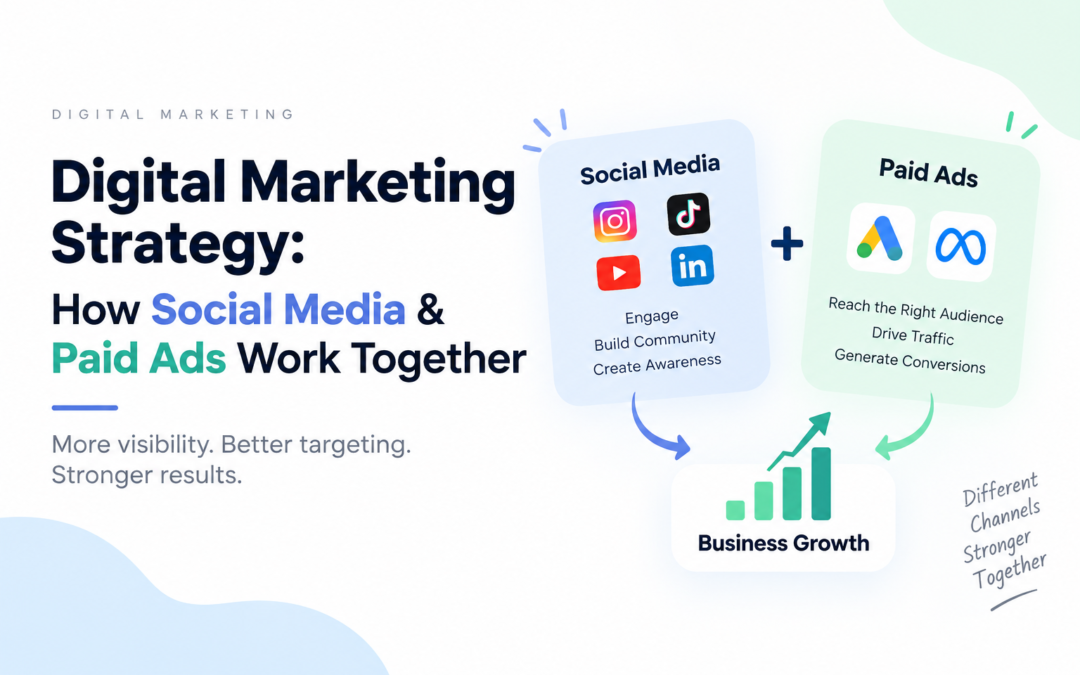
Social media can help people discover and trust your business. Paid advertising can put your offer in front of the right people at the right time. Your website, landing page, sales process and follow-up then have to turn that attention into actual business.
That is where digital marketing becomes more than simply “posting content” or “running ads.”
What Is a Digital Marketing Strategy?
A digital marketing strategy is a structured plan for using online channels to achieve specific business goals.
Those channels can include:
- Search engines such as Google
- Social media platforms such as Instagram, Facebook and LinkedIn
- Paid advertising
- Websites and landing pages
- Email marketing
- Content marketing
- SEO
- Video
The mistake many businesses make is treating each channel as a separate activity.
They post on Instagram because they were told they need social media.
They run Google Ads because they want leads.
They boost a Reel because it received good views.
But none of these activities necessarily connect.
A better approach is to give every channel a specific job.
Social media creates attention and trust.
Paid ads create targeted traffic and demand.
Your website or landing page converts that traffic.
Tracking tells you what is actually working.
Social Media Marketing and Paid Advertising Are Not the Same Thing
This is one of the biggest misunderstandings in digital marketing.
Social media marketing generally involves building an audience and communicating with people through platforms such as Instagram, Facebook or LinkedIn.
This can include:
- Reels
- Carousels
- Educational posts
- Stories
- Community engagement
- Founder-led content
- Testimonials
- Behind-the-scenes content
Paid advertising is different.
Instead of waiting for people to discover your content organically, you pay platforms such as Google or Meta to distribute ads based on your chosen objectives, audiences, keywords, placements or other targeting signals.
Google Ads is particularly useful for capturing existing search demand. Meta advertising can be used across Facebook and Instagram to reach people based on campaign objectives and audience signals.
The two approaches can therefore play different roles in the same marketing system.
How Social Media Fits Into a Digital Marketing Strategy
Think about a person discovering a business for the first time.
They may see a Reel.
They watch another video.
They visit the profile.
They read a few posts.
They look at reviews or testimonials.
They visit the website.
Only after that may they finally become a customer.
Social media can influence several of these steps.
That does not mean every post has to generate a sale.
Some content should simply answer questions.
Some should demonstrate expertise.
Some should show the personality behind the business.
Some should demonstrate results.
And occasionally, content can promote a specific offer.
This is why judging every Instagram post purely by sales can give you the wrong picture.
A post with 50,000 views might not generate a single immediate sale but could introduce thousands of potential customers to your brand.
At the same time, a post with 2,000 views could generate several enquiries because it reached a much more relevant audience.
Reach tells you how many people saw something. It does not automatically tell you how much business it generated.
Where Paid Ads Come In
Organic reach is unpredictable.
You can create a strong piece of content and have it reach thousands of people.
You can create another useful piece of content and have it reach only a fraction of that audience.
Paid advertising gives businesses more control over distribution.
For example, a local dental clinic could use:
Instagram content
To educate people about dental problems and establish trust.
Meta Ads
To reach potential patients with a specific treatment offer.
Google Ads
To appear when someone actively searches for a service such as “dentist near me” or a specific treatment.
Landing page
To explain the treatment, answer objections and provide an easy way to book.
Each component has a different job.
That is much more useful than simply saying:
“We need to do social media.”
Google Ads vs Meta Ads: Why Businesses Often Need Both
Google and Meta advertising can work very differently.
Someone searching Google for:
“best digital marketing agency in Chennai”
has already expressed a certain level of intent.
They are actively looking for something.
Someone scrolling Instagram may not be searching for a digital marketing agency at all.
They might see a useful Reel about increasing leads and realize that their current marketing is a problem.
This creates two different opportunities.
Google Ads captures existing demand
Search advertising can put a business in front of people who are already looking for a particular product or service.
For example:
“home interior designers Chennai”
“best dentist in Chennai”
“performance marketing agency Chennai”
“IELTS coaching Chennai”
The exact opportunity depends on whether enough people are searching for the service and whether the economics make sense.
Meta Ads can create or develop demand
Instagram and Facebook advertising can put products, services and ideas in front of people while they are consuming content.
This can be especially useful for visually driven businesses, ecommerce brands, creators and businesses where discovery plays an important role.
Meta also provides advertising formats such as Reels ads and recommends testing creative and placements rather than assuming one format will work for every campaign.
The important point is that Google Ads and Meta Ads do not have to compete with each other.
They can serve different stages of the customer journey.
The Simple Digital Marketing Funnel
A practical digital marketing strategy can be thought of as a funnel.
1. Attention
Someone discovers your business.
This could happen through:
- Instagram Reels
- YouTube
- Google Search
- Meta Ads
- SEO
- Referrals
2. Interest
They become curious.
They might watch more content, visit your profile or click your website.
3. Trust
They start looking for evidence.
This could include:
- Reviews
- Testimonials
- Case studies
- Educational content
- Before-and-after examples
- Founder content
- Results
4. Conversion
They take an action.
For example:
- Submit a lead form
- Send a WhatsApp message
- Book a consultation
- Make a phone call
- Purchase a product
- Schedule an appointment
5. Retention
The relationship continues after the first conversion.
This could involve:
- Remarketing
- Social media
- Repeat offers
- Customer service
- Loyalty campaigns
A digital marketing strategy becomes much easier to understand when you stop thinking about individual posts and ads and start thinking about this entire journey.
Why Your Ads Can Fail Even When the Ad Is Good
One of the biggest mistakes in paid advertising is assuming that the advertisement is responsible for everything.
It isn’t.
Imagine you run a Meta campaign.
The ad gets clicks.
But the landing page takes five seconds to load.
The offer is unclear.
There is no social proof.
The form asks for 15 different details.
There is no obvious next step.
The campaign may appear to have a “lead problem.”
But the real problem could be the landing page.
The same thing happens with Google Ads.
Google Ads provides conversion measurement that can help businesses understand whether interactions with ads lead to valuable actions such as purchases, sign-ups or calls.
That means you shouldn’t judge a campaign only by clicks.
You need to follow the customer beyond the click.
What Should You Actually Measure?
Different parts of your digital marketing strategy need different metrics.
For social media, you might look at:
- Reach
- Views
- Watch time
- Shares
- Saves
- Profile visits
- Website clicks
For paid advertising, you might look at:
- Cost per click
- Click-through rate
- Cost per lead
- Conversion rate
- Cost per acquisition
- Revenue
- Return on ad spend
For the business itself, the most important metrics may be:
- Qualified leads
- Sales
- Customer acquisition cost
- Revenue
- Profit
This distinction matters.
A campaign can generate cheap leads that never become customers.
Another campaign can generate fewer leads but produce significantly more revenue.
Therefore, cheap leads are not automatically good leads.
A Practical Example: A Chennai Interior Design Business
Imagine an interior design company wants to generate more enquiries.
A disconnected approach might look like this:
Post three Instagram graphics every week.
Boost one post.
Run some Google Ads.
Wait for results.
A more structured digital marketing strategy could look like this:
Social media
Create Reels explaining common interior-design mistakes, budget expectations and design ideas.
Content
Create useful posts answering questions potential customers ask before hiring an interior designer.
Meta Ads
Promote strong creative to relevant audiences and test different offers.
Google Ads
Target high-intent searches related to interior design services.
Landing page
Create a page explaining the service, showing previous projects, answering common questions and providing a clear enquiry option.
Tracking
Measure enquiries and qualified leads rather than simply counting clicks.
Now the channels are working together.
How Much Should You Spend on Paid Ads?
There is no universal answer.
A ₹10,000 advertising budget might be meaningful for one business and almost irrelevant for another.
Your budget depends on factors such as:
- Average customer value
- Profit margin
- Cost per lead
- Conversion rate
- Sales conversion rate
- Competition
- Location
- Customer lifetime value
For example, spending ₹1,000 to acquire a customer may make sense for a business where that customer generates ₹20,000 in profit over time.
It may make no sense for a business where the total profit from that customer is only ₹500.
So instead of asking:
“How much should I spend on ads?”
a better question is:
“How much can I economically spend to acquire a customer?”
That number gives you a much stronger foundation for your advertising strategy.
Should a Small Business Start With Social Media or Paid Ads?
There is no universal answer because the right starting point depends on the business.
Start by looking at the customer’s buying behaviour.
If people regularly search for your service, search advertising may be useful.
If your product is visually appealing and discovery-driven, social content and paid social may play a larger role.
If customers need significant trust before buying, educational content, testimonials and case studies may be particularly important.
If the business already has strong organic content, that content can also provide useful creative ideas for advertising.
The goal is not to be everywhere.
The goal is to be where your customers are and build a system around those channels.
A Simple Digital Marketing Strategy for a Small Business
You don’t need ten different channels to get started.
A simple system could be:
Step 1: Define one business goal
Examples:
Generate 30 qualified enquiries per month.
Generate 50 product sales.
Book 20 consultations.
Step 2: Identify the audience
Understand who you actually want to reach, what problem they have and what normally stops them from buying.
Step 3: Create useful content
Use social media to answer questions and demonstrate expertise.
Step 4: Build a conversion destination
Send interested people to a relevant landing page, product page, lead form, WhatsApp conversation or booking system.
Step 5: Add paid distribution
Test Google Ads, Meta Ads or another appropriate paid channel.
Step 6: Track conversions
Don’t stop at impressions and clicks. Track the actions that matter to the business.
Google’s conversion tools are specifically designed to connect ad interactions with business actions such as purchases, sign-ups and calls.
Step 7: Improve what works
Keep testing your:
- Creative
- Offer
- Audience
- Landing page
- Call to action
- Follow-up process
Digital marketing is not a one-time setup.
It is a continuous process of testing, measuring and improving.
Common Digital Marketing Mistakes
Posting without a purpose
Creating content simply because “we need to post today” usually produces inconsistent results.
Every content piece should have a reason.
Running ads without conversion tracking
If you cannot tell which campaigns are generating valuable actions, you are making decisions with incomplete information.
Optimizing for vanity metrics
Followers and likes can be useful signals, but they aren’t the same as revenue.
Changing campaigns too quickly
Advertising requires enough meaningful data to determine whether a change helped or hurt.
Sending every customer to the homepage
A person clicking an ad for a particular service should ideally land somewhere relevant to that service.
Ignoring the sales process
Marketing can generate enquiries.
It cannot guarantee that every enquiry becomes a customer.
Slow responses, poor follow-up or unclear pricing can cause losses after the marketing has already done its job.
The Best Digital Marketing Strategy Is Not the One With the Most Channels
A business does not automatically need:
SEO + Instagram + Facebook + LinkedIn + YouTube + Google Ads + Meta Ads + email + TikTok.
More channels create more work.
The better question is:
Which channels can we execute well and connect to an actual business objective?
A strong digital marketing strategy could be surprisingly simple.
One platform for attention.
One platform for high-intent demand.
One good landing page.
One clear offer.
One reliable tracking system.
Then improve.
That can be far more effective than spreading a small budget and a small team across every platform available.
How Social Media and Paid Ads Work Best Together
The real advantage comes when the channels inform each other.
Your organic social content can tell you which topics attract attention.
Those insights can influence your paid creative.
Your paid campaigns can reveal which messages generate conversions.
Those messages can influence your future content.
Your website data can show which pages generate enquiries.
Those insights can influence your advertising.
This creates a feedback loop:
Content → Attention → Traffic → Conversion → Data → Better Content → Better Ads
That is the foundation of a mature digital marketing strategy.
Final Takeaway
Digital marketing is not simply about being active online.
It is about building a path between attention and revenue.
Social media can help people discover your brand, understand your expertise and build trust.
Google Ads can capture people who are already searching for relevant products or services.
Meta Ads can help businesses distribute creative to targeted audiences and develop demand.
Your website, offer, sales process and tracking then determine what happens after someone arrives.
The businesses that understand this don’t ask:
“Should we do social media or ads?”
They ask:
“What role should each channel play in getting the customer from discovering us to choosing us?”
That is a much better starting point for building a digital marketing strategy that can actually grow a business.